
The child who doesn’t want to sing

The other day I took my son into an unfamiliar group situation.
Other children were joining in. There were toys. Singing. Activities. All the usual machinery of organised childhood. And my son shut down.
He didn’t want to join the group. He didn’t like the toys. He liked the story but not the singing. He wanted to stay close to me and take his time.
And I became embarrassed.
There it is.
The thing I really don’t want to admit.
I wasn’t only worried about him. I was embarrassed by him.
I wanted him to walk into that room, find another kid, start playing and basically say, “Bye Mum, I’m fine.”
Because I needed a break.
And, if I’m really truthful, I wanted the adults in the room to look at him and somehow reflect something back to me:
You’ve done a good job. Your child is confident. Your child is independent. Your child is okay without you.
Instead, he stood at the edge.
And something in me became furious.

Why won’t you just join in?
Later, after the shame had arrived and started beating me around the head, I realised how familiar the whole thing felt. I wondered if this was something my own mother had felt about me.
That uncomfortable feeling when your child doesn’t behave in the way the room expects. Maybe somewhere along the way we learn that the socially easy child is the successful child.
The one who joins in.
The one who sings.
The one who confidently says hello.
The one who doesn’t cling to your leg while seventeen other children enthusiastically shake maracas.
But some people don’t enter the world like that. Some of us stand at the edge and watch first. We need to understand the room. We want to know who these people are. We want to decide whether any of this is interesting.
Trust takes time.
And perhaps what I found difficult wasn’t my son’s shyness at all. It was that his timing was different from mine. I wanted him ready before he was ready.
“Play needs some degree of safety. You need permission to look stupid without being punished for it.”

Clowns know something about this
I see a version of this all the time when adults come to clown workshops. People arrive wanting to play, but underneath there is often another conversation happening:
Am I doing enough?
Am I funny?
Am I participating properly?
Does everyone else understand this except me?
What does the teacher want?
The body might be standing in the room, while the person is still hovering at the doorway. And forcing play rarely helps.
Play needs some degree of safety. You need permission to look stupid without being punished for it. You need time to understand the people around you. You need to know that you can fail, hesitate, watch, enter, leave and try again.
This is one of the reasons I’m interested in disponibilité in clown training: availability.
Can I actually be available to what is happening?
To the room?
To another person?
To an impulse?
To the fact that right now I have absolutely no fucking idea what to do?
We have strange ideas about participation. We think the enthusiastic person is more engaged than the quiet person. But somebody sitting at the edge of the room may be taking everything in. They may be listening much more closely than the person frantically volunteering for every exercise.
They just haven’t entered yet.

An exercise: Arrive before you perform
One of the things I work with in my workshops is simply arriving in the body. Before we make scenes, personas or jokes, we notice where we are.
Stand.
Feel your feet.
Notice your breathing.
Notice the room.
Notice the other bodies in it.
Walk.
Stop.
Change direction when you genuinely feel the impulse to change direction.
Notice when you are moving because something occurred to you and when you are moving because you think you should be doing something.
That distinction becomes fascinating. We are so accustomed to filling empty space that doing nothing can feel almost unbearable. But clown is full of these little moments.
The audience looks at you.
You look at them.
Nothing has happened yet.
Good.
Stay.
You don’t have to rush ahead and manufacture something.
Sometimes presence arrives before the idea.
“We are so accustomed to filling empty space that doing nothing can feel almost unbearable.”
BIEN!
I have another exercise where the group starts in one corner of the room. One at a time, you run diagonally across the space. Halfway across, you allow a physical gesture and sound to come out. Whatever comes. Then you jump around 180 degrees, continue, and at the finish yell out BIEN! (Good!)
Congratulations! You did a stupid thing in front of everybody. We celebrate the attempt. That matters. Most of us have been trained to wait for evidence that we have done something well before congratulating ourselves. The clown has a different economy.
I tried.
BIEN.
It was terrible.
BIEN.
I had absolutely no idea what I was doing.
Excellent.
BIEN.
The exercise starts to change our relationship with participation. Success is no longer “I impressed everybody.” Success becomes: I entered.
For some people that entrance happens immediately.
For somebody else it might take longer.
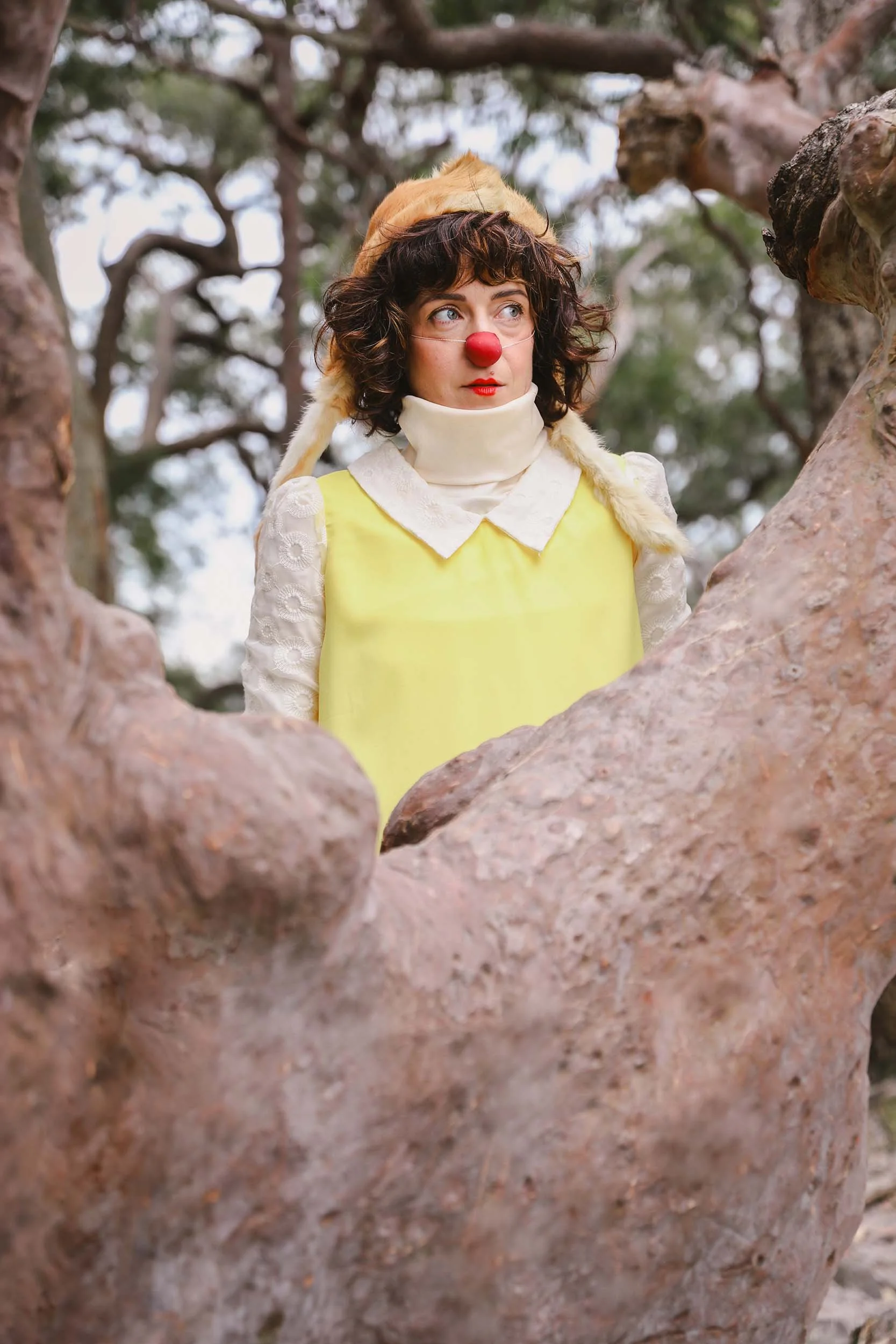
The empty space of possibilities
Another exercise I use begins with two people on opposite sides of an empty space. There is no elaborate scenario waiting for them. There is another human being. There is distance. There is the possibility of movement. And there is time.
What happens if you don’t rush toward an idea?
What happens if you actually see the other person?
Maybe one person moves.
Maybe the other responds.
Maybe nothing happens for a while.
This is where complicité (connection) begins.
Not with cleverness.
With attention.
You can’t manufacture trust between two performers any more than I can manufacture trust between my son and a room full of unfamiliar people. You can create conditions for it. You can invite. You can wait. You can notice.
And eventually something may happen.

Maybe standing at the edge is part of the game
There’s something uncomfortable for me in admitting that I wanted my son to behave differently because his behaviour reflected on me. That hurts. I love this kid.
He is sweet and intelligent and incredibly creative.
And there was a moment when I lost patience with the actual child in front of me because I wanted the imaginary confident child who would give me a break and reassure me that everything was fine.
Parenthood has an unfortunate habit of showing you parts of yourself you would rather leave backstage.
But perhaps this is also where clown helps me. The clown fails publicly. The clown discovers what is actually happening rather than what was supposed to happen. The clown’s great material is often the gap between those two things.
I thought my son would join in.
He didn’t.
I wanted to be relaxed about that.
I wasn’t.
There we are.
That’s the scene.
Now what?
Maybe I can apologise when I lose patience. Maybe next time I can give him longer. Maybe sometimes he will join. Maybe sometimes he won’t. And maybe my job isn’t to make him perform confidence so that I can feel successful.
My job might simply be to keep offering him the world without demanding that he enter it on my schedule. I think we could offer adults the same courtesy.
You don’t have to leap into the centre of the room immediately.
You can watch.
You can listen.
You can think the singing is shit.
You can take your time.
And when something in you finally says:
Okay. I’m ready.
Enter.
BIEN.